
AI and the Future of Work
04 November 2026 (17:00 Berlin)
Artificial intelligence is already changing the ways in which we work. It is altering workplaces, transforming tasks and professions, reorganizing relationships between workers and employers, and changing our understanding of what human labor is for. Yet these changes may only be the beginning. As AI systems become increasingly capable of performing cognitive and creative tasks once associated primarily with human workers, a more fundamental question emerges: what happens to work when the need for human labor itself can be substantially reduced?
This question cannot be separated from the social and economic system in which AI is being developed and deployed.
Contemporary economies are largely organized around competition, productivity, profitability, and the reduction of costs. From this perspective, AI can appear as a particularly powerful technological instrument. If a task can be performed by a machine at lower cost, organizations have strong economic incentives to automate it. If entire categories of labor can be substantially automated, AI may become a means not simply of assisting workers, but of reducing the need for workers altogether.
We are already seeing companies experiment with AI and automation in ways that affect the size and organization of their workforces. But the significance of these developments extends beyond individual companies or particular occupations. If increasingly capable AI systems can perform a growing range of economically valuable activities, we may need to reconsider some of the assumptions on which contemporary working life is built: Why do we work? How is income distributed? What happens to the bargaining power of workers when their labor becomes increasingly replaceable? And what happens to people when employment is no longer the primary way through which they secure not only income, but also social recognition, identity, structure, and a sense of purpose?
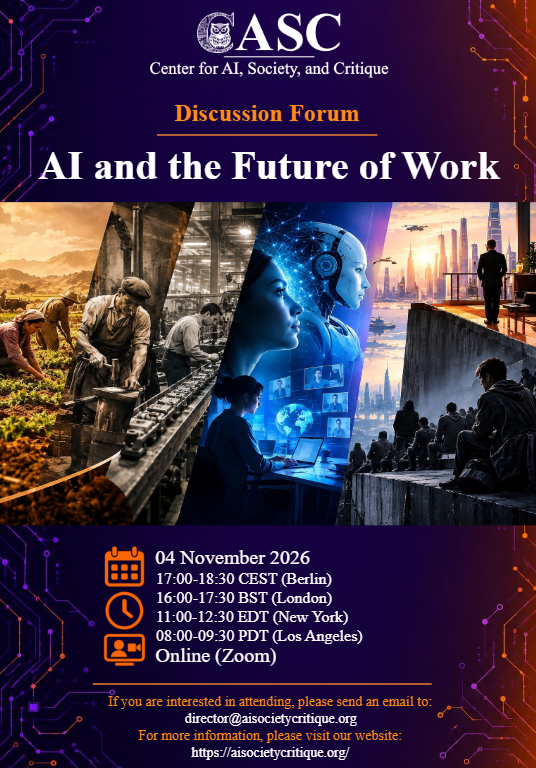
There is also a deeper contradiction worth examining. A technology capable of producing more with less human labor could, in principle, create the conditions for greater freedom: less necessary labor, and more time for human relationships, education, creativity, care, leisure, and self-realization. Yet the same technological capacity can also be used to intensify competition, reduce labor costs, increase surveillance and control, and concentrate economic gains in the hands of those who own and control the technology.
The question, therefore, may not simply be whether AI will take our jobs. It may be more important to ask who benefits from automation, who bears its costs, and what kind of society the technology is helping to produce.
The discussion will explore these tensions from a critical social and cultural perspective. We may consider the changing relationship between humans and their work, the economic incentives driving automation, the changing position of workers, the possibility of widespread displacement, and the ways in which AI may reshape wages, working conditions, and the organization of economic life.
Ultimately, the question of AI and work is also a question about the kind of society we want to live in. If technological development makes it possible for fewer people to perform the labor necessary to sustain society, does this create an opportunity for greater human freedom, or does it deepen existing forms of inequality and insecurity? What happens when productivity increases without a corresponding transformation in how its benefits are distributed? And if work becomes less necessary, how might we rethink the place that work occupies in human life?
These are some of the questions we hope to open up in the discussion. The aim is not to arrive at a predetermined answer, but to create a space in which the economic, social, psychological, and cultural consequences of AI-driven transformations of work can be examined critically and collectively.