
The Journal of AI, Society, and Critique is an international, open-access, and peer-reviewed journal dedicated to the critical examination of artificial intelligence as a social, cultural, and epistemic phenomenon. Rather than treating AI as a purely technical domain, the journal situates algorithmic systems within broader architectures of meaning, power, ideology, and social practice that structure contemporary life. It provides a space for scholarship that investigates how intelligent systems shape perception, organize attention, and redefine the boundaries of collective experience. The journal is published by the Center for AI, Society, and Critique (CASC).
JASC is grounded in the conviction that AI is never neutral in its effects, even when it appears neutral in design. It is embedded in and shaped by existing forms of rationality, governance, and valuation, and it often participates in the reproduction of these structures. The journal welcomes interdisciplinary work from sociology, philosophy, media theory, anthropology, psychology, and political theory that examines not only the functioning of AI systems but also the conceptual assumptions, institutional conditions, and cultural logics that inform their development and deployment. Particular attention is given to how algorithmic mediation reshapes subjectivity, public discourse, labor, decision-making, and everyday life, as well as to the broader ideological environments in which these processes unfold.
The journal is committed to exploring AI as part of the evolving infrastructure of contemporary existence, including its role in emerging forms of mediated interaction, data-driven governance, and the reconfiguration of autonomy under conditions of optimization and prediction. As an open-access venue, JASC seeks to make critical scholarship widely accessible and to foster a global space for reflection on the societal implications of AI. Ultimately, it aims to deepen understanding of how these systems shape what is seen as possible, desirable, and thinkable, while contributing to scholarly and public efforts to imagine more reflective and humane technological futures.
Publication Information
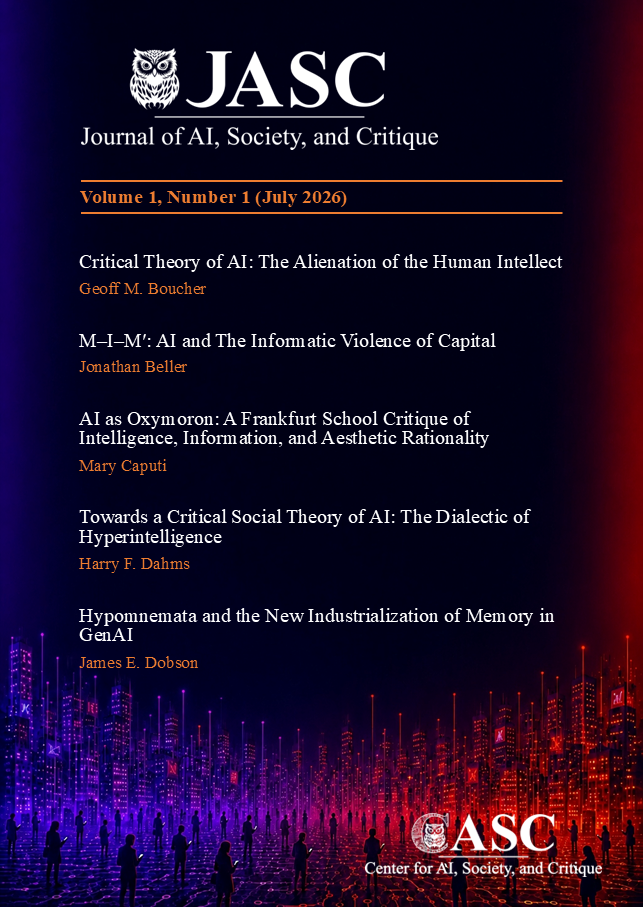
Click on the cover to download the issue