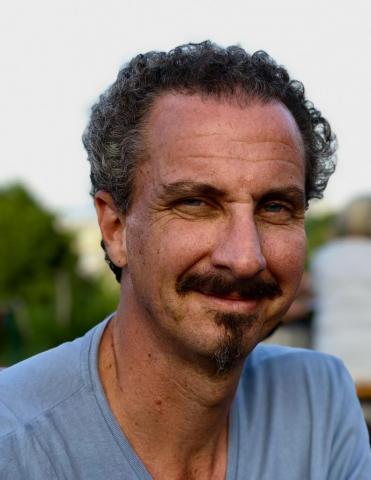
Stefan Bird-Pollan (D.Phil. Oxford, in German Literature; Ph.D. Vanderbilt, in Philosophy) is Professor of Philosophy at Wayne State University. His research focuses on how the notion of subjectivity is related to intersubjectivity in modern moral and political philosophy as well as in aesthetics.
He was the University of Vienna Fulbright Professor for Humanities and Social Science for the academic year 2014/2015. In May of 2018, Bird-Pollan held a Fulbright Specialist award at the University of Parma to lecture on the topic of psychoanalysis and populism. He also held the Sigmund Freud Stiftung Fulbright 2020, in Vienna.
His book The Dialectic of Emancipation; Hegel, Freud and Fanon, which places Frantz Fanon’s social critique in the tradition of German idealism, appeared in 2015 (Rowman and Littlefield).
He has published articles on Immanuel Kant, G. W. F. Hegel, John Rawls, Herbert Marcuse, T. W. Adorno, Walter Benjamin, Sigmund Freud, John McDowell, Stanley Cavell, and Charles Mills, as well as on the topics of the relation between populism and liberalism, intersectionality, the question of race, and the unconscious. He has also edited (with Vladimir Marchenko) a volume on the relation between Hegel’s aesthetic and Hegel’s political thought, Hegel’s Political Aesthetics (Bloomsbury, 2021).
In recent years, he has divided his research focus between a book on Kant and ongoing work in social and political philosophy. In his Kant manuscript, he argues that Kant is best understood as offering a transcendental account of the struggles and experiences involved in the human attempt to achieve autonomy. He contends that the model for Kant’s project is that of a scientist whose quest to understand nature is an effort to make the world more hospitable for humanity.
Outside of his work on this manuscript, his other publications have focused on a variety of topics in social and political philosophy: he has written three papers in which he uses psychoanalytic theory to understand the way that authoritarian populism breaks with traditional liberal theories of politics. He has also recently returned to the work of Theodor Adorno in an attempt to understand authoritarian politics. One of his recent papers explored Adorno’s conception of fascism as a potentiality within capitalism, and he intends to carry this work forward in what he hopes will become his next book project. Another current project explores the connection between epistemology in Kant and Stanley Cavell, as well as the connection of that topic to Cavell’s philosophy of film.