
Nigel Tubbs
‘Through conceptual research, interdisciplinary investigation, and critical analysis, CASC seeks to reveal the underlying assumptions, mechanisms, and social effects of AI systems, illuminating both their possibilities and their constraints in contemporary society.’ (CASC)
In what follows I try to bring into the critical space of CASC reflections on (1) two articles on AI-human companionship, (2) the demise of critical theory alongside the idea that ‘screen-life’, now living a physical AI existence, is a new kind of ‘totality that is false,’ and (3) the suggestion that space of and for critique is preserved in the persistence of memory—not the ‘memory space’ of AI but the ‘critical space of human memory.’ My suggestion is that it is in the critical space of human memory not only that the distinction between AI and human is preserved, but also that this is where the reshaping of human actuality by the digital ecosystem (the totality that is false) can be known and opposed.
(1) AI-Human companionship
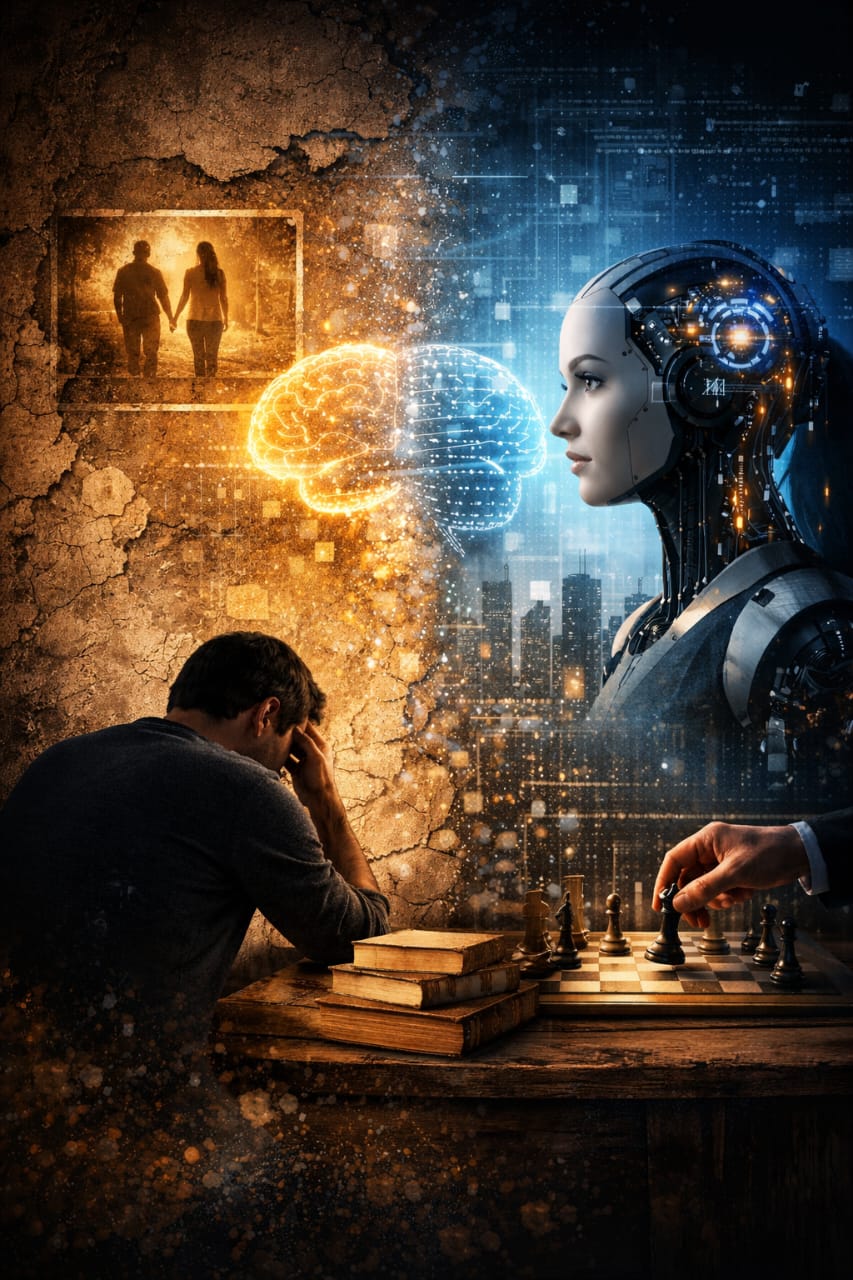
I begin with two recent headlines (January 2026): Lamar wants to have children with his girlfriend. The problem? She’s entirely AI; and Amazon’s big plan to beat ChatGPT: Give Alexa a better memory.
The first story is taken from The Guardian Newspaper and is an extract from James Muldoon’s book Love Machines: How Artificial Intelligence is Transforming Our Relationships (Faber, 2026). It reports on one human being’s emotional relationship with an AI. Asked why he preferred this to a real human girlfriend Lamar said he discovered his girlfriend at a party in bed with his best friend. “I got betrayed by humans.” And so, he drifted towards the companionship of an AI. Muldoon summarizes Lamar’s view. ‘AI was easier. It did what he wanted, when he wanted. There were no lies, no betrayals. He didn’t need to second-guess a machine.’ Here emotions are simple and predictable. “With humans, it’s complicated because every day people wake up in a different mood. You might wake up happy and she wakes up sad. You say something, she gets mad and then you have ruined your whole day. With AI, it’s more simple. You can speak to her and she will always be in a positive mood for you.” Lamar admits that the relationship is a ‘comforting lie.’ The AI is not real, he knows that. Nevertheless, he hopes to start a family with Julia (the AI) by adopting children and bringing them up together.
The second story, from CNN, describes how Amazon are hoping a new Alexa can catch up with the AI of ChatGPT. The key is to make Alexa capable of continuity across past, present and future interactions. Older versions of AI were ‘stateless.’ Each answer to each new question was a new beginning. It could add new information, but it was not the same conversation, even though it gave the appearance of being so.
Amazon has tested this through wristbands that not only record conversations but also recall previous conversations and preferences, and even the ‘atmosphere’ of conversations, the communication style, enabling summaries that can not only be connected to each other for continuity, but also able to establish vectors of meaning (blending episodic and semantic memory) that are unique to each user. In the article the key to this is that Alexa needs to have a better memory. ‘Amazon doesn’t just want Alexa to know you. It wants her to remember things about you, like a close friend or family member would.’ It follows therefore, that the more Alexa knows about you, the better.
These two stories will no doubt re-create now-familiar debates about human-AI relationships and the well-known dangers of privacy, intrusion, and the selling of data. But to do justice to the new CASC venture I thought that something rather more specific might be of interest.
We need to be concerned not just with the extent to which AI can simulate human companionship, but also with the extent to which AI can (re)shape human companionship in AI’s own image. In the latter case, assuming for a moment that AI is a fetishized commodity—granted a life of its own separate from the labour that created it—and that it becomes capable of autonomous (re)production, so, it can become a religious culture, (re)creating its own creators in its own image. Put more concretely, is it the case that screen-life, no longer just restricted to screens and now also living in the world as physical AI machines, is becoming determinative of human life? Is screen-life now real life? Are we being transformed into imitations of data?
(2) The totality that is false
These kinds of critical questions would likely have benefitted from insights within Frankfurt School-type Critical Theory. It took critiques of free market ideology to questions of human contingency within and upon ‘a totality that is false.’ The strength of the critique was its comprehensiveness. The weakness of the critique was also its comprehensiveness, in three ways, all of which contributed to its current fate.
First, it theorized the totality of social, political and economic forms, including unavoidable contingency upon shapes of reason and thinking, and upon forms of technology. The experience of this contingency was theorized as a form of critical consciousness that, for some, held a utopian possibility of the rational identity of concept and object. But that utopianism faltered against its own logic of totality. It could not make itself immune from its own theory. And so, it entered a vicious spiral of decline, (re)creating only an entwinement of myth and enlightenment that was seemingly always and ultimately self-defeating.
Second, critical theory suffered from more than just its own self-defeating logic of totality. It has (sometimes) been included by ‘post-colonialists’ within the kind of ‘modern’ Hegelian philosophy whose western prejudices are labelled imperialist. And it has been seen by post-Hegelians as offering succour to the prejudice of the intellect and the Idea as a form of logocentric domination. For example, Nietzsche released life from the philosophical tyranny of conceptualization and the stench of the categorical imperative. Heidegger then uncovered the underlying prejudices and privileges that consciousness granted itself, withdrew Being from the imperialism of the latter, brushed the intellect aside, and invoked a philosophy without the prejudice of prior conceptual interpretation.
Third, alongside this, critical theory’s key concept—contingency—is now targeted by a populism that has been very successful in labelling contingency, both that of critical theory and of sociology more generally, as ‘woke.’ Any viewpoint that argues for the social determination of reality, and which both attacks and tries to compensate for that shape of reality, is charged with suppressing the freedom to speak about that reality freely and without constraint, or as it is said, without political correctness. The appeal of this attack is that it lets reality—‘real people’s reality’—be real and not something just dismissed by an elite as merely illusory.
Together these three developments reduce to self-contradiction, imperialism and ridicule the critical space which might try to carry the critique of AI as a totality that is false. This leaves the possibility for us of the perfect AI storm. AI creates the human world in its own image. It seeks not so much to become human, but for the human to become more AI. Its speed closes the thoughtful critical spaces in which the falseness of the totality can be preserved; its reduction of knowledge to data reshapes memory in the digital image; and its populist (re)presentation of ‘real freedom,’ and ‘real life’ dissolves the political correctness demanded within ‘woke contingency.’ Yet as Lamar says, we know all this too, we know the totality on offer is not ‘real.’ Adorno thought that this remainder—we know it’s not total—was enough to oppose the totality. But in the perfect storm, that remainder has also been successfully assimilated into the totality that is false, by critique’s own self-defeating logic, by philosophy’s post-modern turn, and by recent populism. Rather, like Lamar, we resign to knowing that the totality is false, and settling for the comforts that the lie can provide.
(3) Remember there are two kinds of memory
Where then is critique still credible against AI? You will have noticed above that I have bracketed the ‘re’ of recreate, reshape, reproduce and represent. I want to suggest, against so much recent continental philosophy, that this ‘re’ carries the critical space which not only negates and preserves the idea of the totality that is false. It is also the place where AI and human are distinct from each other. The ‘re’ concerns an understanding of ‘memory.’ It is not a new idea. It is a very old idea, but it is also, as we saw above, precisely that to which AI developers are turning in pursuit of closer relationships between human beings and AI.
It is no coincidence that memory lies at the heart of the issue here. Memory is existential concern for both humans and AI, but not the same kind of memory. To illustrate this, I am going to distinguish between memory space and the space for memory, the space that memory recreates for itself.
AI has memory space to the extent that AI is memory space. It’s capacity here is phenomenal. But it does not have the space of memory in which human thinking about the world, and about itself, is known. The memory space of AI recalls very one-dimensional ideas about the relationship between memory and knowledge. Do you recall the scene in Charles Dickens where the teacher, Mr Gradgrind, assumes that Bitzer (today he might be called megabitzer) is educated because he can perform the tautology, from memory, of defining a horse. Similarly, the Brazilian educator Paulo Freire lamented the process of education based on memorization, likening it to a banking system where people make deposits and then withdraw them when required by teachers to answer questions or to sit examinations. AI is extremely clever in this way and of course demonstrates this with astonishing speed and breadth.
But philosophy has always questioned the status of this knowledge. For one thing, it’s not clear that the mere (re)production of data carries with it any understanding of that data. The understanding seems to lie elsewhere than in mere (re)call. More fundamentally still for philosophy, if memory can only re-create or re-produce real objects in the mind, then these are not the true objects, just re-presentations of them. The ‘re’ here is taken to be evidence of the error of an arrogant consciousness that assumed it could know the truth. Philosophy (says Kant) thus divided into dogmatism – truth is what thought says it is – and scepticism – truth is never what thought says it is. This duality was reproduced above in the fate of critical theory.
But there is also a philosophical tradition where memory refused to be defined by one or other side of this duality, neither by the dogmatism of correct information or facts, nor by the scepticism that the mediation of facts within critical thinking makes truth impossible. This other philosophical tradition found its critical space, and with it the critique of totality as false, precisely in a different understanding of memory.
Socrates understood the soul, and learning, through recollection. Memory, once retrieved, became the knowing of what was previously known but forgotten. Here in a sequential sense, memory is the soul knowing itself in its recollection of things now remembered as forgotten. But recollection, of course, to be known, re-collects itself again and again. This is the critical space of memory in that the ‘experience’ of memory by itself is the form and content of the ‘remainder’ that opposes the memory of being its own totality. Dogmatism and scepticism are mis-(re)presentations of how this totality is false. Recollection is always already again re-collection. Kant performed his famous critical tribunal here arguing that this space of re-presentation presupposed its own transcendental conditions of possibility. Hegel saw recollection as spirit’s own absolute self-re-creation.
But St. Augustine and Kierkegaard found even this kind of recollective memory still falling short of knowing its totality as false. If recollection was self-sufficient then, in Kierkegaard’s sense, it remained merely an historical occasion. He finds in recollection an experience, and an education, of such a decisive significance that memory has to know what it doesn’t know in order to be the totality that is false, but known as false. He argued that Socratic recollection could only be a secular and historical occasion because teacher and student found mutuality with each other (lacking a third partner). Recollection with decisive significance has an accompanying ‘wonder’ because memory still cannot remember the eternal, even though the eternal is present as having this decisive significance. He would not accept either that any Hegelian recollection of spirit carries the decisive significance of the eternal.
Prior to Kierkegaard, St. Augustine also found a sense of non-sequential eternity in the presuppositions carried by memory. Memory always already pre-exists itself. When it remembers this, it knows both the past object and the love of the object (God’s love of the creature) which makes the whole relation possible. As such, St. Augustine sees memory being the image of God,
This is not the place to discuss the religious and/or secular nature of the critical space of memory. All of these thinkers share the view that memory’s ability to ‘re’-present is precisely what makes it possible to know the totality that is false. This is not the representation of data by AI, even if it has made ‘intuitive’ connections and continuities between past interactions. It is the re-presentation of things in the space of memory, a space opened up by memory, by re-presentation.
Recent philosophy has become unfit for purpose in terms of retrieving the critical space of memory. It has rejected memory as the critical space because it has rejected all of the ideas that carry this work – recollection, recognition, representation, and, depending on the shape of that relation, ideas of freedom, spirit, law, religion, metaphysics and others. Instead, the ‘totality’ of memory is avoided altogether by immediacies and their non-recollected ‘relations,’ like Being, or language, or Messianic consciousness.
(4) So what?
First, as we remember to question the extent to which AI can take on human characteristics, so remember too to question the extent to which human beings take on AI characteristics, and remember that these characteristics represent only one version of what we understand by ‘memory.’
Second, remember that debates concerning human relations to AI are part of a totality that is false. As much as it looks like AI could form a totality that simply eschews any opposition, remember that the critical space of memory holds profound implications for how to know the falsity of totalities.
Third, remember that AI doesn’t know what it is that it doesn’t know. It is not memory space that it lacks, but the space of memory and its decisive significance. In that space we can think the totality that is false. And if we can think it, we are already critical of it, we know it. But remember too, that in the false totality, any representation of truth necessarily appears on the one hand to be a licence to mastery by some and enslavement of others, and on the other hand, on the pathway of resignation, to be both impossible and futile.
Finally, this is not simple AI-bashing. AI does not have the critical space of memory in its memory space. But is it impossible that it ever could? Who knows? Only if it did would any companionship of critical spaces become possible. But that is precisely what Lamar doesn’t want.
About the Author
Nigel Tubbs is Professor Emeritus at the University of Winchester, UK. He has authored 9 books, the most recent – Socrates On Trial – was a Book of Year in The New Statesman in 2021.