
Brian L. Ott
In our contemporary digital world, new technologies emerge at a rapid pace, shaping not only the way we communicate but also how we perceive, understand, and interact with our surroundings. Among these technologies, artificial intelligence (AI) has garnered particular attention not simply as a computational tool, but as a cultural and epistemic force. AI’s increasing presence in education, work, media, and daily life invites us to reflect on how it is transforming human thought, behavior, and social structures. Yet the conversation around AI often oscillates between extremes, between alarmist declarations of its harms and uncritical celebration of its potential. This essay seeks to provide a more measured perspective grounded in medium theory, emphasizing AI’s structural biases, while situating its impacts in a broader historical and cultural contexts.
Technology and Bias: A Media Ecology Perspective
As a media ecologist, my work examines how new technologies alter our social environment, thereby reshaping human cognition, perception, and behavior. Central to this approach is the recognition that technologies are never neutral. As Lance Strate
These biases are not passive properties of technologies, but active epistemic programs that shape human understanding and practice through repetitive use. As Neil Postman (1992) once famously wrote, “To a man [sic] with a hammer, everything looks like a nail” (p. 14).
Computers, and by extension AI systems, are similarly biased, which makes them more effective and useful at accomplishing some tasks than others. For instance, AI excels at data processing, pattern identification, and repetitive calculation. In doing so, it heightens and promotes speed and efficiency. At the same time, AI has limitations. Computational technologies do not “think” in the human sense, as they lack consciousness, agency, subjective experience, and moral reasoning. Consequently, repeated exposure to AI’s biases and limitations encourages particular habits of mind and behavior. In Postman’s (1992) words: “To a man [sic] with a computer, everything looks like data” (p. 14).
From the perspective of media ecology then, AI is not a neutral and inert tool, but a set of technologies whose design, engineering, and deployment condition human sense-making and activity.
AI and the Misconception of Intelligence
A central challenge in contemporary public discourse is the widespread conflation of AI’s computational abilities with human intelligence. Large language models, such as ChatGPT, can generate coherent text, quickly access, retrieve, and share information, and summarize complex datasets. But these capabilities do not imply thinking or understanding in the human sense. AI operates by detecting statistical patterns in vast datasets, predicting likely outputs, and simulating coherent responses. It does not possess consciousness, reflective awareness, or moral judgment.
This distinction is critical. When AI is framed as “intelligent” or “creative” by developers and marketers, users may be tempted to defer cognitive effort to machines, wrongly assuming that the technology is capable of reasoning, reflecting, and thinking. Such assumptions risk creating an environment where humans increasingly rely on algorithmic outputs without sufficient critical, intellectual, and ethical engagement. However, it is important to emphasize that these effects are not inevitable. Human oversight, education, and mindful use can mitigate potential overreliance, ensuring that AI functions as a tool to facilitate or enhance thinking rather than as a replacement for it.
Historical Parallels and Technological Mediation
The idea that technologies shape our habits of mind and behavior is not new. Marshall McLuhan (1988) famously argued that each medium amplifies certain human capacities while attenuating others. Writing heightens sequential thinking, the telegraph alters our sense of time and context, and computers enhance computational speed. Similarly, Neil Postman (1992) highlighted how technology mediates culture, shaping our values, beliefs, and practices in subtle and sometimes not so subtle ways. From a media ecology perspective, AI can be seen as the latest in a long line of technological mediators, whose influence is profound but not predetermined.
Historically, each new technology has prompted both optimism and anxiety. Concerns about “dehumanization” often accompany innovations that shift cognitive and social practices. Just as the printing press reshaped literacy and the telegraph transformed temporal and spatial experience, AI alters how knowledge is produced, validated, and disseminated. What distinguishes AI is the scale and speed at which it operates, as well as its ability to simulate tasks previously reserved for human cognition. Understanding these transformations requires careful empirical and conceptual analysis.
AI, Data, and Cultural Bias
AI systems are built on data, and data is itself never neutral. AI systems reflect the implicit cultural biases of the datasets on which they are trained, the algorithms with which they have been programmed, and the objectives pursued by their designers. These cultural biases, as opposed to the technological or structural biases I described earlier, can reinforce existing inequalities, marginalize certain voices, and perpetuate stereotypes. Media ecologists are concerned with cultural as well technological biases because they influence not only what AI outputs, but also how humans interpret and act upon those outputs
Yet even here, nuance is necessary. AI does not impose bias automatically, as it operates within specific social, political, and organizational contexts. The responsibility lies with designers, regulators, and users to identify, mitigate, and correct biased datasets, algorithms, and outputs. Awareness of bias, combined with transparent practices and ethical guidelines, is crucial for harnessing AI for socially constructive purposes.
The Illusion of Objectivity and the Politics of AI
Beyond cognitive biases, AI’s purported neutrality conceals a deeper political and epistemic dimension. The design of algorithms, the selection of training data, and the prioritization of performance metrics are embedded with values and assumptions that reflect the interests of corporations, governments, and technocratic elites. This “illusion of objectivity” fosters a perception that AI outputs are factual or authoritative, discouraging scrutiny of the social and ideological frameworks underpinning them.
Consequently, AI can reinforce existing power structures, privileging certain perspectives while marginalizing others. From a media ecology standpoint, these effects are not incidental but intrinsic: the medium conditions not only how knowledge is produced but whose knowledge is recognized as legitimate. Recognizing AI’s epistemic and cultural biases is essential for cultivating critical engagement, ensuring that human judgment and ethical deliberation remain central in a landscape increasingly mediated by digital intelligence.
AI and Human Agency
A common critique of AI is that it diminishes human agency. While AI can automate repetitive cognitive tasks, humans remain uniquely capable of interpretation, judgment, and moral reasoning. What changes is the division of labor: certain cognitive functions may be delegated to machines, freeing humans for more creative, artistic, and conceptual work. In this view, AI can potentially enhance human agency if integrated thoughtfully into workflows and educational systems.
The risk arises when delegation becomes abdication, i.e., when humans rely on AI to the point of disengaging from critical thinking or ethical reflection. This is not a technological inevitability but a sociocultural challenge, one that requires dedicated attention to education, policy, and institutional norms.
Toward a Balanced Assessment
AI’s societal implications are complex, multifaceted, and context-dependent. It is neither likely to destroy nor save us. Rather, it is a set of tools whose influence is mediated by social, cultural, and institutional practices. A balanced perspective acknowledges both AI’s potential harms and benefits, recognizing that it can simultaneously enhance, constrain, and transform human thought.
From a media ecology perspective, AI is not a monolithic force acting upon passive humans. Humans interact with, interpret, and adapt AI technologies, shaping their effects in diverse ways. By cultivating digital literacy, ethical awareness, and reflective practices, we can leverage AI to extend human capacities while mitigating potential negative consequences.
Conclusion: Navigating the Age of Digital Mediation
We live in an age where digital technologies, including AI, are inextricable from daily life. The challenge is not to reject AI wholesale or to embrace it blindly, but to critically examine how it shapes human cognition, social interaction, and cultural values. AI embodies particular biases—toward data processing, pattern recognition, and simulation—that condition human habits of mind and behavior. How we respond to these influences will determine whether AI serves as a tool for intellectual enrichment or a source of cognitive complacency.
The task of scholars, educators, policymakers, and users is to engage AI thoughtfully, with awareness of its affordances, limitations, and social consequences. In doing so, we honor the complexity of human-technology interaction, recognizing both the transformative potential of AI and the enduring necessity of human judgment, creativity, and ethical responsibility.
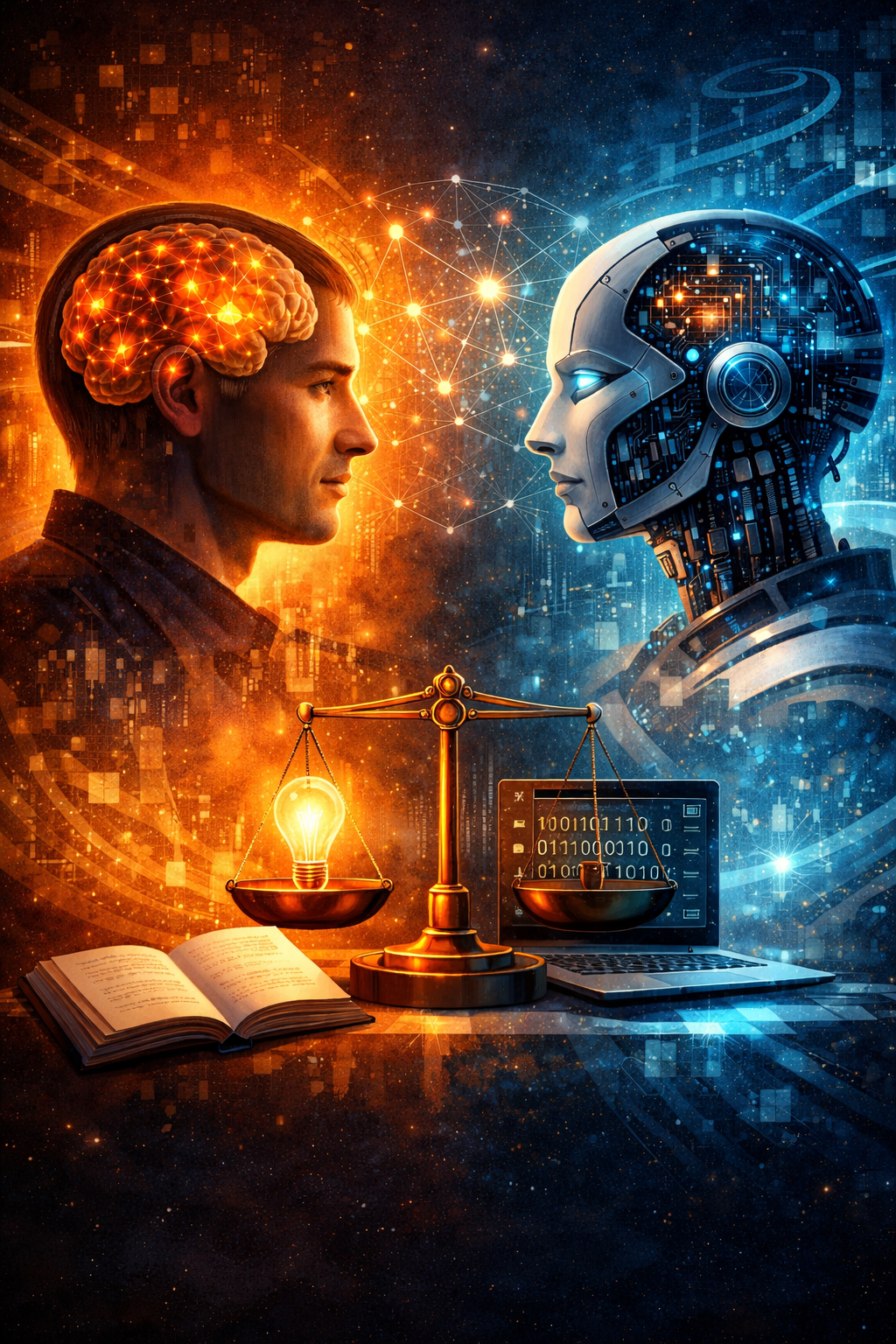
AI is both a mirror and a mediator. It reflects the cultural biases of the datasets and algorithms it utilizes, and it reproduces the structural biases that define it as a distinctive technology. But by treating this technology with care and critical attention, we have the opportunity to envision an age not of dis-enlightenment, but one of deliberate, informed, and reflective mediation.
References
McLuhan, M., & McLuhan, E. (1988). Laws of media: The new science. Toronto: University of Toronto Press.
Postman, N. (1992). Technopoly: The surrender of culture to technology. New York: Alfred A. Knopf.
Strate, L. (2012). If it’s neutral, it’s not technology. Educational Technology, 52(6), 6–9.
About the Author
Brian L. Ott is Distinguished Professor of Communication and Media at Missouri State University. He is currently working on a book titled, Digital Beings: How the Structural Biases of Digital Media Shape Our Habits of Minds, which explores the ways in which digital media are fundamentally transforming our communication, culture, and consciousness.