
Howard Eiland
The question of what constitutes a work of art was a longstanding concern of Walter Benjamin. In his influential essay of the later 1930s, “The Work of Art in the Age of Its Technological Reproducibility,” which to the last he considered a work in progress, he speaks of a “world-historical upheaval” arising from the “shattering of tradition,” an upheaval that has engendered “the present crisis and renewal of humanity” (Benjamin, 2003, pp. 258, 254). The third version of the essay carries an epigraph from contemporary poet and critic Paul Valéry that views the “profound changes…impending in the ancient craft of the Beautiful” in the context of post-Newtonian science: “For the last twenty years, neither matter nor space nor time has been what it was from time immemorial. We must expect great innovations to transform the entire technique of the arts, thereby affecting artistic invention itself and perhaps even bringing about an amazing change in our very notion of art” (p. 251). Benjamin likewise refers, in the Work of Art essay, to profound changes consequent on modern technological innovation, changes both in human apperception, whereby the processing of perceptions is altered, and in the nature of art, whereby the work of art becomes a construct (Gebilde) with comparatively new functions (p. 257). Instead of an auratic instrument of
magic, as in prehistoric times, or an auratic object of religious veneration, as in the Middle Ages, the artwork becomes, as Benjamin terms it, an assembled (montierbar) organon of history, by means of which the historical significance of the audience’s own present day is made manifest through the representation of other times and places (Benjamin, 2002, p. 109; 1999c, p. 464). The artwork’s cult value recedes before its exhibition value and, as Charles Baudelaire already noted in the mid-nineteenth century, the artist enters the marketplace; the work of art becomes a commodity. The social function of art is accordingly revolutionized. “Instead of being founded on ritual,” Benjamin writes, “it is based on a different practice: politics” (Benjamin, 2003, p. 257). We should understand politics here in a broad sense encompassing the technologization of life.
Technologization, in Benjamin’s view, entails both potentially dangerous tensions and the possibility of “immunization,” the defusing of such tensions through critical engagement with them—crisis and renewal (Benjamin, 2002, p. 118). He focuses on the art of film because, with its structural foundation in horizontal and vertical montage, which can shatter and revolutionize the tradition of storytelling, it epitomizes the artwork as assemblage. Moreover, of all the arts, cinema best mirrors the new perceptual forms and the new dynamics—the rhythms, the violence, indeed the psychoses—of modern times, so that its reception, through which an audience gains mediated experience of these dynamics, can bring about the requisite immunization. It is both destructive and cathartic in effect. Hence, in that other unending work in progress, The Arcades Project, wherein literary montage bespeaks a non-totalizing unity, an articulation of dispersion in dis-integrated form, Benjamin can write that “all problems of contemporary art find their definitive formulation only in the context of film” (Benjamin, 1999a, p. 394 [K3,3]). By means of the dynamic visual resources of the film camera, with its “prismatic” revelation of unexpected stations in the most ordinary milieux, its disclosure of a vast new Spielraum or field of action, the technological medium of film makes possible, as we read in the Artwork essay, a “deepening of apperception throughout the entire spectrum of optical—and now [with sound film] also auditory—impressions” (Benjamin, 2003, p. 265). What Benjamin regards as the shock effect of film—the continuous change of image, the continuous discontinuity—can work to heighten attention. Film is to become the training ground for a new and opened out, kinetic apperception, a productive “reception in distraction” geared to the challenges of modern life (p. 269).
Technology, then, for Benjamin is Janus-faced—constituting both promise and peril. Cinema brings to light the specifically modern and ever intensifying interpenetration of reality with equipment, with “the apparatus,” as Bertolt Brecht likes to say (Benjamin, 2003, pp. 263-64). It was poet and playwright Brecht (from whom Benjamin also borrows the famous term “aura”) who characterized film in terms of “sympoesis,” as opposed to individual authorship (Werber, 2003, p. 231, citing Brecht’s 1930 essay “Der Dreigroschenprozess” [The Threepenny Lawsuit]). Benjamin likewise stresses the collective nature of film production along with the interplay of human and machine in the dialectic of actor and camera. He writes in the Artwork essay that the most important social function of film is to establish equilibrium (Gleichgewicht) between human beings and the apparatus, making it possible for the apparatus—this would hold for AI—to become an object of human innervation, a stimulus to production and creativity, although it can also be put to use, Benjamin warns (thinking perhaps of filmmaker Leni Riefenstahl’s 1935 Triumph of the Will), for reactionary political purposes (Benjamin, 2002, p. 117). At the essay’s end, after referring to the increasing “proletarianization” or dispossession of modern humanity and the increasing formation of masses, he concludes that society has not been mature enough to make technology its “organ” and, correlatively, that technology has not been sufficiently developed to master “the elemental forces of society.” Once an object of admiration for the Olympian gods in Homer, humankind now presents a picture of self-alienation (pp. 120-22).
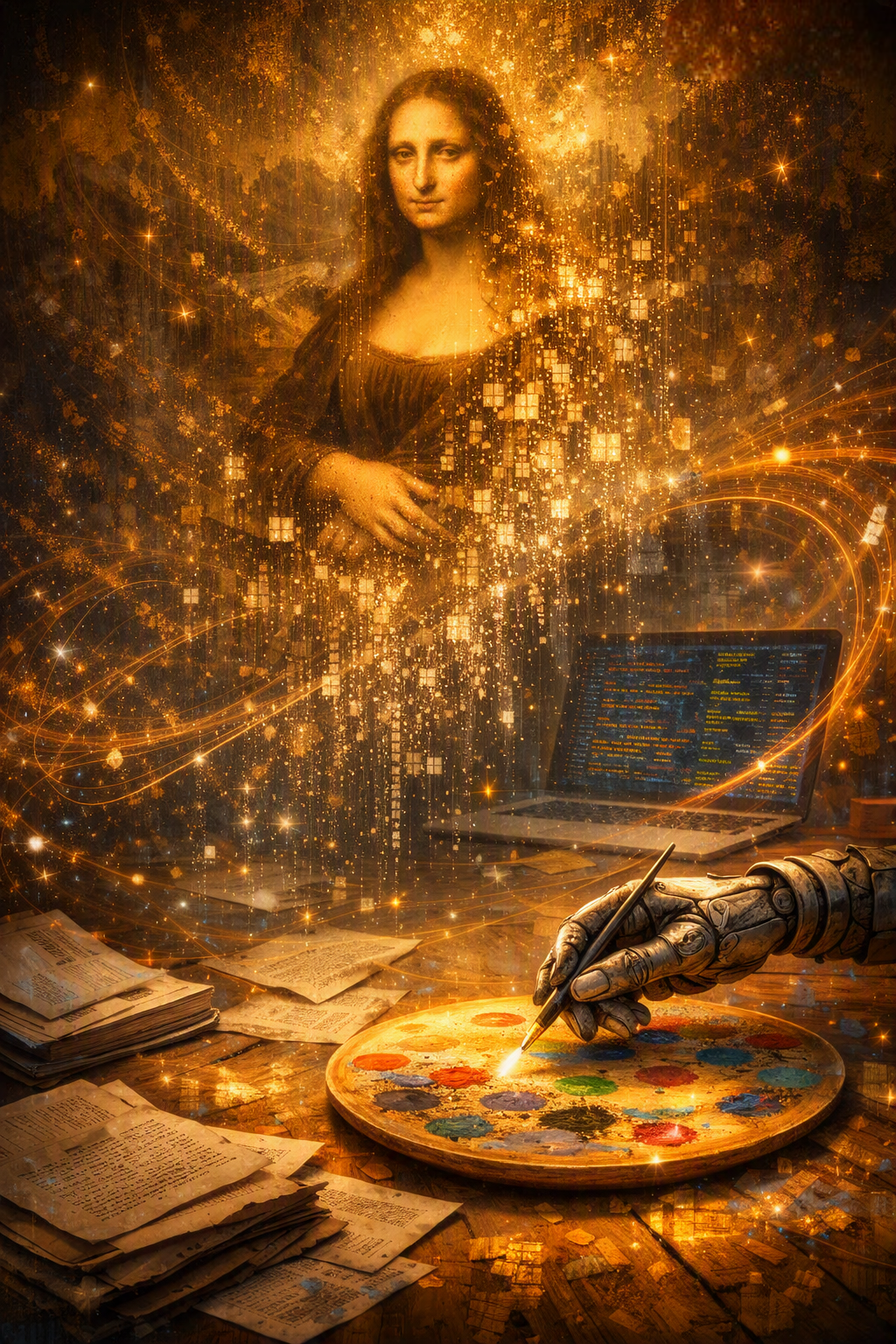
In the ninety years since the composition of the Artwork essay, technology has certainly developed. The computer has worked far-reaching changes in the daily life of humans, but, at the present moment particularly, it is worth returning to Benjamin’s question as to whether technology is sufficiently developed to overcome elemental forces of society, such as greed and the lust for power. Benjamin’s characterization of the technological apparatus in terms of interaction is also worth keeping in mind. AI is, of course, not a discrete object but—to use Benjamin’s signature term—a constellation, a multimedia integrative system, itself part of a more general socio-technical system. It makes possible a new mode of intertextual assemblage and association, calling for a new mode of associative reading. The resulting docuverse of intertextualities generates a Spielraum in which the relation between individual and collective is transformed.
In other words, the fate of the artwork in the age of AI is intimately connected to the fate of individuality. In Benjamin’s 1931 essay “Karl Kraus,” on the popular Viennese satirist and performance artist who railed against mounting conformism, he cites Karl Marx’s statement that the truly individual human being is one who has become a “species-being.” That is the mark of what Benjamin calls here the “real humanism,” with its “cosmopolitan rectitude” (Benjamin, 1999b, pp. 454, 456). He thus seems to raise the possibility—in this evolving negotiation, if not hybridization, of humans with the apparatus—of a broadened, decentered humanism and a worldly individualism, a stewardship, if not sovereign control, of the machine.
Benjamin was keenly aware, in 1935-1936, of the dangers posed by a possible appropriation of the new media by the emerging fascist powers. The perils of AI—the capacity for mass surveillance and weapon automation, for example—are coming to light along with its promises—in regard to medical and biological research, for example. It is conceivable that the technology of AI could itself help meet Benjamin’s call for critical engagement with technologization, thereby promoting equilibrium between humanity and the apparatus. No doubt Benjamin would want, in addition, to entertain a distinction between knowledge and information, and between selfhood and agency. In what sense, if any, is there an experiencing, and not just grammatical, “I” in the AI chatbot? With all its deep learning and hypertextual porosity, will artificial intelligence ever be able to illuminate human life as fully and richly as does that enigma we call the work of art?
References
Benjamin, Walter, 1999a. The Arcades Project, trans. Howard Eiland and Kevin McLaughlin.
Cambridge, MA: Harvard University Press
Benjamin, Walter, 1999b. “Karl Kraus,” trans. Edmund Jephcott, in Benjamin, Selected Writings, Vol. 2, ed. Michael W. Jennings, Howard Eiland, and Gary Smith.
Cambridge, MA: Harvard University Press, pp. 433-458.
Benjamin, Walter, 1999c. “Literary History and the Study of Literature,” trans. Rodney Livingstone, in Benjamin, Selected Writings, Vol. 2, ed. Michael W. Jennings, Howard Eiland, and Gary Smith. Cambridge, MA: Harvard University Press, pp. 459-465.
Benjamin, Walter, 2002. “The Work of Art in the Age of Its Technological Reproducibility” (Second Version, 1935-36), trans. Edmund Jephcott and Harry Zohn, in Benjamin, Selected Writings, Vol. 3, ed.
Howard Eiland and Michael W. Jennings. Cambridge, MA: Harvard University Press, pp. 101-133.Benjamin, Walter, 2003. “The Work of Art in the Age of Its Technological Reproducibility” (Third Version, 1936 or 1939), trans. Harry Zohn and Edmund Jephcott, in Benjamin, Selected Writings, Vol. 4, ed. Howard Eiland and Michael W. Jennings. Cambridge, MA: Harvard University Press, pp. 251-283.
Werber, Niels, 2003. “Media Theory After Benjamin and Brecht: Neo-Marxist?,” trans. Almut Müller, in Mapping Benjamin: The Work of Art in the Digital Age, ed. Hans Ulrich Gumbrecht and Michael Marrinan. Stanford, CA: Stanford University Press, pp. 230-238.
About the Author
Howard Eiland is a scholar of Walter Benjamin and media theory, exploring intersections of culture, technology, and critical thought. He taught in the Literature Section at MIT from 1982 to 2014 and received the 2011 Levitan Prize for Excellence in Teaching. He has published articles on twentieth-century literature and philosophy and is author, with Michael W. Jennings, of Walter Benjamin: A Critical Life (2014). He is a translator of Benjamin’s works such as The Arcades Project (with Kevin McLaughlin), Berlin Childhood around 1900, and Origin of the German Trauerspiel. His Notes on Literature, Film, and Jazz appeared in 2019.